Tag: nasa

  • Artemis II and the Future of Lunar Bases: Why Humanity Is Returning to the Moon

    Artemis II and the Future of Lunar Bases: Why Humanity Is Returning to the Moon

    In April 2026, NASA’s Artemis II mission marks a historic milestone—50 years after the last crewed mission to the Moon. This mission is not about landing; it’s a ten‑day test flight that will send four astronauts on a lunar flyby to validate the systems and procedures needed for future lunar landings. The long‑term vision, however, goes far beyond this single mission: NASA aims to establish permanent bases on the Moon by the 2030s, turning the lunar surface into a scientific laboratory, a staging post for Mars, and a hub for economic and strategic activities in space.


    The Artemis II Mission: A Crewed Flyby for Future Landings

    Artemis II is the second flight of the Space Launch System (SLS) rocket and the first crewed mission of the Orion spacecraft, making it the first crewed mission beyond low Earth orbit since Apollo 17 in 1972. The mission, launched from Kennedy Space Center, carries four astronauts—NASA’s Reid Wiseman, Victor Glover, Christina Koch, and Canadian Space Agency astronaut Jeremy Hansen—on a free‑return trajectory around the Moon before returning to Earth.

    The primary goal of Artemis II is to demonstrate the capabilities of the crew and systems in deep space. Astronauts will test life‑support, navigation, and communications in real‑flight conditions, while NASA evaluates the performance of the SLS/Orion stack. This mission is designed to ensure that the technology and procedures are ready for Artemis III and beyond, which aim to land humans on the lunar surface in the late 2020s.


    The Purpose of Permanent Lunar Bases

    The Artemis program is not just about revisiting the Moon; it’s about creating a sustained presence there. NASA’s long‑term goal is to build a semi‑permanent lunar base at the Moon’s south pole, a region rich in water ice and other resources. This base will serve as a hub for scientific research, a training ground for Mars missions, and a platform for economic and strategic activities in space.

    Scientific Research and Exploration

    Lunar bases will enable long‑term scientific research that was impossible during the short Apollo missions. The Moon’s surface preserves ancient rocks and impact records that provide insights into the early history of the solar system and Earth. Bases will allow astronomers to conduct observations from the lunar surface, particularly from the radio‑quiet far side, and to study the Moon’s geology, interior, and the effects of cosmic radiation.


    A Staging Point for Mars and Beyond

    The Moon is an ideal testing ground for Mars missions. From a lunar base, astronauts can practice living in partial gravity, using in‑situ resources, and operating in harsh environments, all much closer to Earth than Mars. This experience will be crucial for preparing for the long‑duration missions required for Mars exploration.

    Access to Lunar Resources

    Water ice found in the Moon’s polar regions can be split into oxygen and hydrogen for breathing air and rocket propellant. This will reduce the need to launch resources from Earth, making deep‑space missions more cost‑effective. Other minerals and materials on the Moon could be used for construction and manufacturing, supporting a growing lunar economy.

    Economic and Strategic Opportunities

    Permanent lunar bases could open up new economic opportunities, including mining, 3D‑printed construction, and space tourism. They will also give countries and alliances a strategic foothold in space, influencing space policy, governance, and security. As other nations like China pursue their own lunar ambitions, a sustained presence on the Moon will be crucial for maintaining leadership in space exploration.


    The Roadmap to a Permanent Lunar Presence

    NASA’s plan for sustained lunar exploration involves a phased approach. Initial missions will deploy satellites and autonomous rovers to explore the lunar surface, identify resource‑rich areas, and confirm the presence of water. Robotic missions will prepare landing sites by leveling the ground and solidifying the dusty surface, minimizing damage from lunar dust during landings.

    Following these preparatory missions, human landings will begin, with Artemis III marking the first crewed return to the lunar surface since Apollo. Subsequent missions will focus on building and expanding the lunar base, with the goal of achieving a semi‑permanent human presence by the 2030s. This long‑term vision will lay the groundwork for future missions to Mars and beyond, transforming the Moon into a cornerstone of humanity’s spacefaring future.


    Conclusion

    Artemis II represents the first step in a new era of lunar exploration, a 50‑year gap since the last crewed mission to the Moon. While this mission focuses on testing systems and preparing for future landings, its ultimate purpose is far more ambitious: to establish permanent bases on the Moon that will serve as scientific laboratories, staging posts for Mars, and hubs for economic and strategic activities. As humanity looks to the stars, the Moon will once again become a place where dreams of exploration and discovery are realized.
  • 31/ATLAS: The Interstellar Visitor Passing Through Our Solar System

    31/ATLAS: The Interstellar Visitor Passing Through Our Solar System

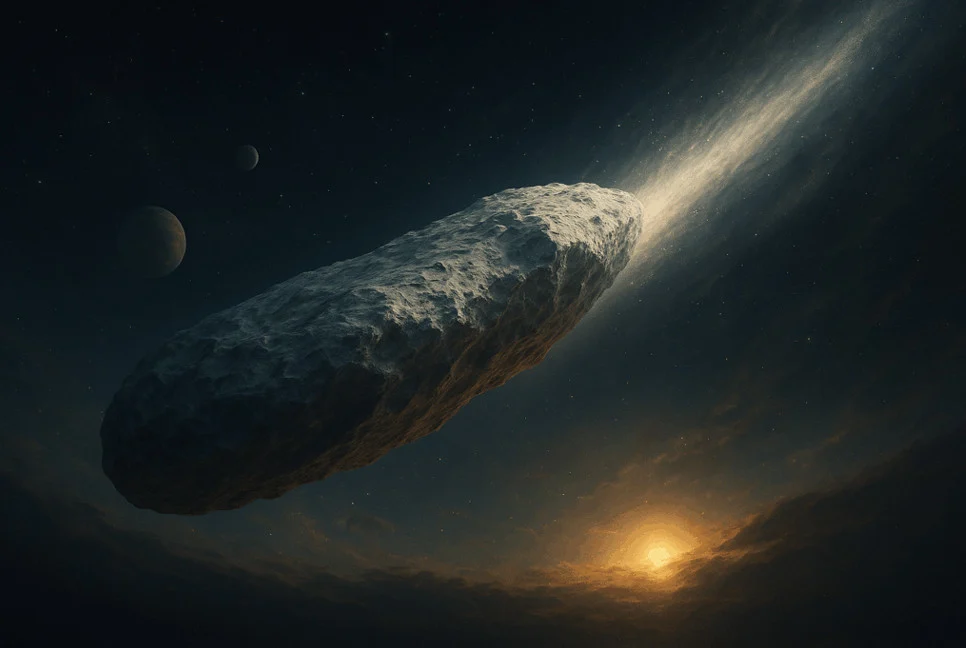
    In 2025, astronomers discovered a remarkable celestial object named 3I/ATLAS, also known as comet C/2025 N1 (ATLAS). This comet is special because it is only the third confirmed interstellar object—originating from outside our solar system—ever observed passing through our cosmic neighborhood. Its arrival has sparked curiosity, scientific study, and also some sensational media attention. This article unpacks what 31/ATLAS is, why it is important, and what it means for humanity.


    What Is 31/ATLAS? Natural or Artificial?

    3I/ATLAS is a natural interstellar comet. It possesses a solid icy nucleus, and as it nears the Sun, volatile ices sublimate to form a glowing coma of gas and dust, visible through telescopes. Observations spanning many instruments—including NASA’s Hubble and James Webb Space Telescopes—reveal typical cometary features such as a dust tail and gas emissions rich in carbon dioxide and unusual chemical elements like nickel, but with little iron. There is no credible evidence of artificial origin; it is not an alien spacecraft or probe. Speculations about artificiality exist but remain outside the scientific consensus.

    Is 31/ATLAS a Threat to Humanity?

    The comet passed its closest approach to the Sun on October 29, 2025, and its trajectory has kept it safely away from Earth—no closer than about 1.8 astronomical units (AU), nearly twice the distance between Earth and the Sun. It continues on a hyperbolic path which means it came from outside the solar system and will leave again, not staying or settling in our celestial neighborhood. There is no threat to humanity from this comet.

    Media Coverage and the Role of Propaganda

    The arrival of 31/ATLAS generated broad media interest, mixing solid scientific reports with speculative and sometimes alarmist narratives. Some fringe theories and conspiracy claims framed the comet as a portent or alien technology, largely fueled by social media and internet talk shows. However, established scientific organizations and leading astronomers have consistently emphasized its natural origin and harmless passage. Thus, while the public conversation may have had sensational aspects, these do not amount to propaganda manipulation, merely public fascination amplified by incomplete understanding.


    Scientific Observations in Detail

    Since its discovery in July 2025, 31/ATLAS has been closely monitored by dozens of observatories and major telescopes. Notable findings include:

    • Detection of cometary activity even when 31/ATLAS was about 6.4 AU from the Sun (before discovery), indicating sublimation of super-volatile ices other than water.

    • Imaging of an asymmetrical cyanide gas coma spanning approximately 180,000 kilometers as of September 2025.

    • Visible dust tails expanding to about 100,000 kilometers, consistent with typical comet behavior.

    • Spectroscopic studies showing unique chemical signatures with high nickel content but sparse iron.
      The comet’s brightness and activity levels have remained steady, with no unexpected outbursts as it passed through perihelion.

    Religious and Cultural Interpretations

    Outside scientific circles, some religious interpretations see 31/ATLAS as a divine sign or celestial messenger, linking it symbolically to themes of judgment or prophecy. These views rely on metaphorical readings of ancient texts and cultural traditions, reflecting human attempts to find meaning in rare cosmic events. While culturally significant for some groups, these interpretations remain separate from the empirical scientific understanding.

    Nevtis phone,cloud,helpdesk

    Should the Public Be Concerned?

    For the average person, there is no reason to worry about 31/ATLAS. It poses no impact risk to Earth and offers a rare and exciting opportunity for scientists to study an object from another star system in real time. Media buzz and online trends may create hype, but understanding comes down to appreciating this comet as a natural visitor passing through briefly before continuing its journey into interstellar space.

    Conclusion: A Cosmic Messenger, Not a Threat

    Interstellar comet 31/ATLAS is a fascinating, authentic astronomical phenomenon—a natural comet from beyond our solar system giving humanity a glimpse into the materials and conditions of other star systems. While it drew some sensational claims, careful scientific study confirms it is not artificial, not threatening, and not a tool of propaganda. It reminds us of the vastness of space and the many mysteries waiting to be explored.


    This comprehensive review should serve well for a detailed blog article covering the science, media narratives, cultural views, and public advice around comet 31/ATLAS based on the most current knowledge and observations in 2025.